

Ancestra at Playhouse Square
From February 22 through March 3 Ancestra, a play directed by Holly Holsinger (CSU chair of Theatre & Dance), will be staged at Playhouse Square with a sister production at Oberlin College. Written by Holly Holsinger and Chris Szajbert in 2014 and updated in 2023, the idea for the play was sparked by the National Women’s Rights Convention in Cleveland Ohio that took place at Melodeon Hall from October 5-7, 1853 (see the proceedings housed in the Library of Congress).
Global Interconnections & Public Narratives
Ancestra provides a unique opportunity for Social Studies and history majors in HIS 370/570 “Global Interconnections” to think about historical sources as materials for public narratives. Whether that narrative is in the creative arts, like Ancestra, or in an open resource, like Wikipedia, these narratives often serve as an entryway to a deeper understanding of world history. Since many of our Social Studies majors go on to become educators, we will explore the creation and potential of narratives throughout the semester.
Enter Wiki Education
As we brainstormed connections between the narrative of Ancestra and world history, it became clear that one way to augment experiences of the performance would be to make the narratives and biographies of historical individuals and events highlighted in the play easily accessible. One key resource for this type of information is Wikipedia. By editing and improving articles related to Ancestra’s narrative on Wikipedia, HIS 370 students will provide theatre goers with a resource to learn more about the inspiration for the play while enhancing an area in the online encyclopedia that will serve a general audience as well. Indeed, we identified eleven articles on Wikipedia related to historical content in Ancestra. Only one out of these eleven articles, Lucy Stone, earned a “good” article ranking from Wikipedia. The room for improvement in the areas of women’s rights, African-American women’s history, and the 1853 National Convention for Women’s Rights in Cleveland is clear.
The Wiki Education Process
Admittedly, HIS 370 came to the Wiki Education process a bit late. If you are planning to use Wiki Education in a course, be sure to plan ahead and register with Wiki Education. We did so at the beginning of the spring 2024 semester with the guidance of Mandi Goodsett, Performing Arts & Humanities librarian at Michael Schwartz Library. In addition to connecting us to relevant Wikipedia resources, Mandi created an excellent research guide and conducted a class discussion for the students. We are now in Week 5 of the semester and well on our way through the carefully curated editing project provided by Wiki Education. You can view our public class page here: https://en.wikipedia.org/wiki/Wikipedia:Wiki_Ed/Cleveland_State_University/Global_Interconnections_(Spring_2024)
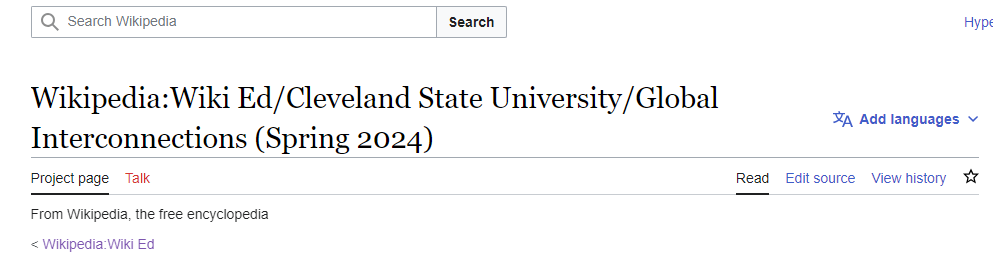
As an instructor I am impressed by the level of design and instructional support provided by Wiki Education. The project is adaptable but requires a minimum of six weeks. The classroom platform provided by Wiki Education is filled with training modules, exercises, and sandbox spaces for students to become familiar with Wikipedia’s research and editing processes.
Student Perspectives and First Impressions
The “Global Interconnections” students are blogging about their experience with this project on our class discussion board and will continue to do so throughout the project. Here are some of our conversations from the first two weeks of our project.
- Wikipedia as a source. Students expressed unfamiliarity with Wikipedia as a reliable source and tool for research. Many students indicated that they were discouraged from using Wikipedia in their PK-12 education for various reasons. This experience leaves them with two major impressions as we start the project: 1. that they are unfamiliar with the platform and its format and 2. that they are apprehensive about contributing to these public narratives.
- Public Narratives on Digital Platforms. We discussed the role of public narratives on digital platforms in class. The discussion also touched on who controls digital narratives, thinking about the format and function of Wikipedia. I introduced them to the idea of “hyperlink narratives,” a term used by Kelly McCullough and James Retallack in their analysis of German History in Documents and Images. Wikipedia articles thrive on the connections established through hyperlinks that link articles within the encyclopedia. In this way, a reader can read an article from top to bottom, or click through a series of hyperlinks, thus creating their own unique narrative. McCullough and Retallack argue, “While the hyperlink has the power to ‘pull’ information together, it can also create narratives, intended or not.” (360) As we work through our editing process, our class will pay attention to hyperlinks, not only adding research content to articles but making useful connections through hyperlinks. In addition we will recognize that some narratives will be generated by the users as they navigate through Wikipedia materials.
Stay Tuned
We’ll continue to blog about our Wikipedia project journey and collaboration with the Ancestra team here through Spring 2024. Check this space for our next blog post and get your tickets for Ancestra (https://www.playhousesquare.org/events/detail/ancestra) today!
About the Author: Shelley E. Rose is Associate Professor of History and Women’s & Gender Studies at Cleveland State University. She is the director of the Social Studies program and her teaching and research focuses on digital humanities, protest history, and gender studies. See her EngagedScholarship@CSU profile for recent scholarship and teaching materials.
Further Reading & Works Cited
Goodsett, Mandi. “HIS 370 World History: Wikipedia Editing Project,” Research Guide, Michael Schwartz Library. Accessed February 13, 2024. https://researchguides.csuohio.edu/HIS370/wikipedia
Library of Congress, “Proceedings of the National Women’s Rights Convention held at Cleveland, Ohio, on Wednesday, Thursday, and Friday, October 5th, 6th, and 7th, 1853.” Accessed February 13, 2024. https://www.loc.gov/item/93838288/
McCullough, Kelly, and James Retallack. “Digital History Anthologies on the Web: German History in Documents and Images.” Central European History 46, no. 2 (2013): 346–61. http://www.jstor.org/stable/43280586.
Wiki Education, “Teach With Wikipedia,” Wiki Edu. Accessed February 13, 2024. https://wikiedu.org/teach-with-wikipedia/
