
BY IAN MILLER
When a worn 18th century sampler is laid carefully on a padded table under soft studio lights, it tells more than a story of needle and thread, it presents centuries of global history, cultural exchange and everyday life. For students at Cleveland State University, that sampler, and hundreds of other objects in the Education Art Collection, is slowly being transformed into high-resolution photographs, metadata and lesson-ready curriculum. What began as a joint pilot project with the Cleveland Museum of Art is steadily becoming a model of how physical cultural heritage can travel beyond gallery walls and into classrooms everywhere.
That collaboration aims to digitize the 10,000 objects in the Education Art Collection, making it accessible to educators, students, and researchers, and pairing Education Art Collection digitized object with historical context and pedagogical guidance. Through that work, campus and museum are creating a resource that blends original artifacts, archival scholarship, and digital-humanities tools, giving new life to objects once destined to sit unseen.
FROM LENDING CASES TO DIGITAL FILES: WHAT IS THE EDUCATION ART COLLECTION
The Education Art Collection predates the opening of the Cleveland Museum of Art. According
to the archival history, the Education Art Collection was founded in 1914, originally under the name “Extensions Collection,” as a portable microcosm of the museum, meant to bring art to schools, libraries, and community centers across Cleveland and beyond. Today, the collection includes about 10,000 authentic works of art from around the world, spanning more than 5,000 years of human history.
Unlike those in the main museum collection, many Education Art Collection objects were intentionally selected so they could be handled under supervision, a design feature meant to support close, tactile, multi-sensory learning.
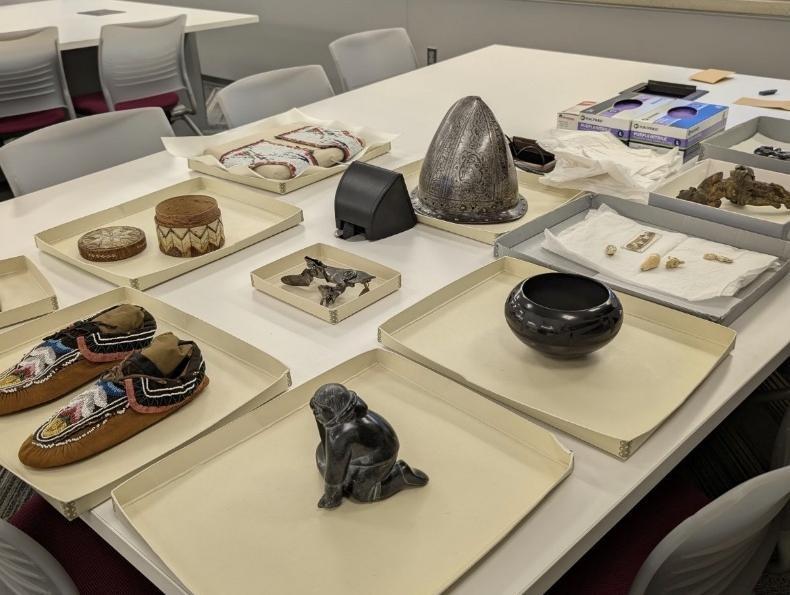
Over decades, the Education Art Collection supported over 32,000 mini-exhibitions in schools, libraries, and community centers around Cleveland before the original “Extensions” program ended in 1992.
In recent years, the Cleveland Museum of Art’s education and curatorial staff have revived the Education Art Collection’s mission through museumled outreach programs such as “Art to Go” and “Art Up Close,” which allow community members and school groups to interact firsthand with selected Education Art Collection objects.
A PARTNERSHIP TAKES SHAPE
The collaboration between Cleveland State University and the Cleveland Museum of Art grew out of a shared vision: turning the museum’s vast but under-digitized resource into an accessible educational tool. According to Shelley Rose, a history professor at Cleveland State University, she discovered the Education Art Collection and realized its potential almost immediately but was disheartened by the lack of images or robust data for many objects. She proposed a partnership: “we have students … and we have the interest, can we help?” Rose said. The museum agreed.
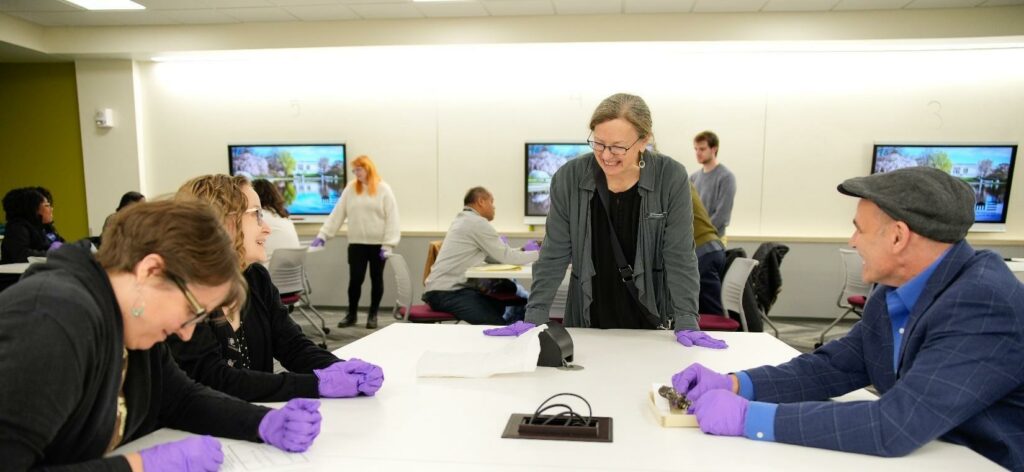
Thus began a pilot project, with undergraduate and graduate students joining museum staff to digitize items and build a curriculum around “teaching with objects.” Rose described success so far in concrete terms: getting objects to Cleveland State University classrooms, enabling students to collaborate with them directly and beginning to create data and instructional materials.
From the museum side, Sabine Kretzschmar, director of the Education Art Collection, emphasized that digitization is not just about cataloging; it aligns with the Cleveland Museum of Art’s educational mission. She said the collection currently only exists as a list in many cases, unphotographed and difficult to browse. Digitization, she explained, would make the Education Art Collection searchable and accessible online, enabling teachers, researchers and community members to explore the collection independently rather than relying on museum staff.
INSIDE THE DIGITIZATION: PROCESS, CHALLENGES, AND PEDAGOGY
At the core of the project’s methodology is hands-on work by students such as undergraduate assistant Jez Lambert. As Lambert described in her interview, her role involves assessing physical objects, for example, samplers, documenting their materials, motifs, and condition, and then preparing them for photography. She records data about fabric types, decorative details (alphabets, borders, animal, or religious motifs) and any areas of fading or beading.
Then come the photography sessions, managed in a designated studio with professional equipment: controlled lighting, neutral backgrounds, and a “color bar” reference to ensure faithful color reproduction in digital images. Lambert noted that the process is more complicated than, “just taking a picture and throwing it on the website.” After photos are taken, master-quality files are generated, color calibrated and then entered along with metadata into the museum’s database (Athena). From there, curators can integrate the digitized objects into their digital catalog.
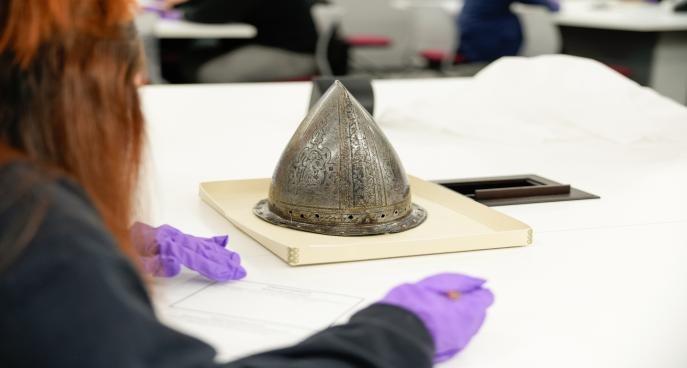
Kretzschmar explained why the pilot began with samplers: they are flat, two-dimensional objects of similar size, ideal for the first round of digitization. The Education Art Collection’s full scope includes 10,000 objects ranging across works on paper, textiles, ceramics, armor, decorative arts, and archaeological artifacts, many of them three-dimensional, making them more time and resource intensive to photograph.
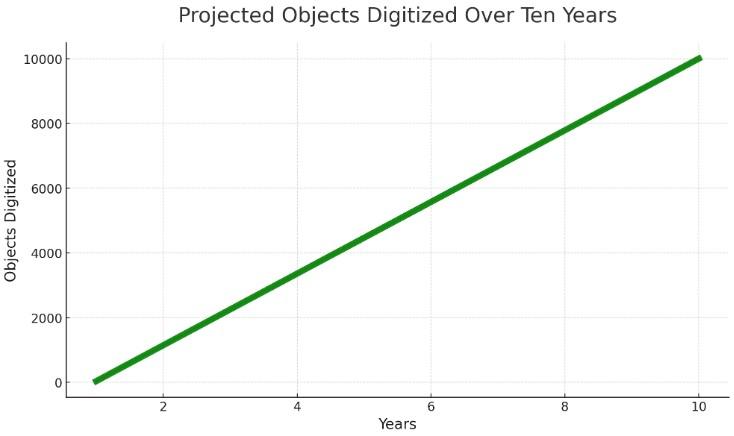
Because of the variety and volume of objects, Kretzschmar noted that full digitization may take years, perhaps even a decade, depending on funding, personnel availability and the complexity of certain objects.
Despite the challenges, the collaboration’s educational ambitions are large. Rose said she hopes students will not only gain practical skills (data management, photography, archival work) but also learn how to use objects as starting points for historical narrative, inquiry and teaching. In her courses, she describes assignments where a single object, a sampler, a Roman artifact, or a piece of ceramics, becomes a lens through which broader cultural, gender, labor or global history questions are explored.
WHAT DIGITIZATION COULD UNLOCK: ACCESS, TEACHING, AND EQUITY
Once digitized and organized into a publicly accessible database, paired with contextual data and curricular resources, the Education Art Collection could become a powerful tool for teachers, students and researchers. As Kretzschmar noted, many Native North American objects are part of the Education Art
Collection; currently about 90% of the museum’s Native North American holdings are in the education collection rather than the main collection. With digitization, users could search for objects by culture, region, medium, or theme and discover artifacts they might never have known existed. Rose envisions regular coursework built around the Education Art Collection: cataloging classes, global history surveys, art history electives and even education-major pedagogy courses that teach future K-12 teachers how to build object-based lesson plans. She reports that multiple instructors have already committed to using Education Art Collection objects in their classes next semester.
Moreover, that project could serve as a model for other museums and universities seeking to democratize access to cultural heritage, combining curatorial standards, archival rigor and student driven scholarship.
CONCLUSION: FROM STORAGE ROOM TO VIRTUAL CLASSROOM, A NEW CHAPTER FOR THE EDUCATION ART COLLECTION
The digitization collaboration between Cleveland State University and the Cleveland Museum of Art is not just about converting artifacts into pixels. It is about rethinking how art, history and material culture can live, not behind glass, but embedded in teaching, research and community engagement. By melding student labor, museum expertise and pedagogical ambition, the project breathes new life into a collection nearly as old as the museum itself and promises far reaching access to 5,000 years of human creativity.
If all goes well, what began as a semester long pilot with a few samplers could expand into a dynamic, ongoing resource, a “teaching collection for the world,” open to any curious mind.
About the Author: Ian Miller is a meteorology major at Ohio University. He kindly granted permission to publish this article on Social Studies @ CSU.
